The review is in! If you were at Music That Shimmers, enjoy a look back at the concert that launched our 2026/27 season. If you couldn’t make it, this review offers a glimpse of a performance filled with colour, imagination and a touch of chocolate.
Okanagan Symphony’s Shimmering Season Opener
By Nicholas Kelly, October 9, 2026
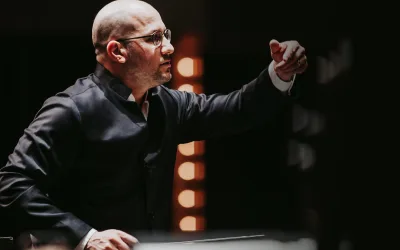
This past weekend, the Okanagan Symphony Orchestra opened their 2026-2027 season with Music That Shimmers. While this marked the beginning of Julian Pellicano’s second season as Music Director, it was his first season opener onstage conducting. And if last weekend’s concert was any indication, he’s already taking the orchestra in exciting new directions.
Pellicano’s chemistry with the orchestra was evident from the first beat as he led them through a program of largely uplifting, often celebratory music. And to set the festive tone, the concert began with… dessert.
Yes, Montréal composer Maxime Goulet’s Chocolats Symphoniques was paired with actual chocolates–available for the audience to purchase–supplied by Sandrine French Pastry & Chocolate in Kelowna. I was unable to partake, but the music itself was an adequately gourmet experience.
While the audience might have felt like kids in a candy store hearing Goulet’s playfully sparkling use of orchestral colour and stylistic pluralism, achieving this effect required a great deal of skill and restraint from both the composer and performers. The attractive textures were meticulously balanced, showing off every section of the orchestra’s stylistic range as they transitioned seamlessly from cinematic romanticism (“Caramel Chocolate”) to a fiery habanera (“Dark Chocolate”) to the more atmospheric, texture-driven music of “Mint Chocolate”.
In the latter, the string section may have stolen the show with their pristine blend of harmonics and tremolo to create a unique and memorable shimmer–the closest musical analogue I can imagine to ice sheets slowly drifting and cracking. But the OSO’s woodwind section leaders are the ones who really made this movement sing. They executed their wispy, exposed solos with quiet confidence and precision, lending structure and direction to the strings’ more atmospheric music.
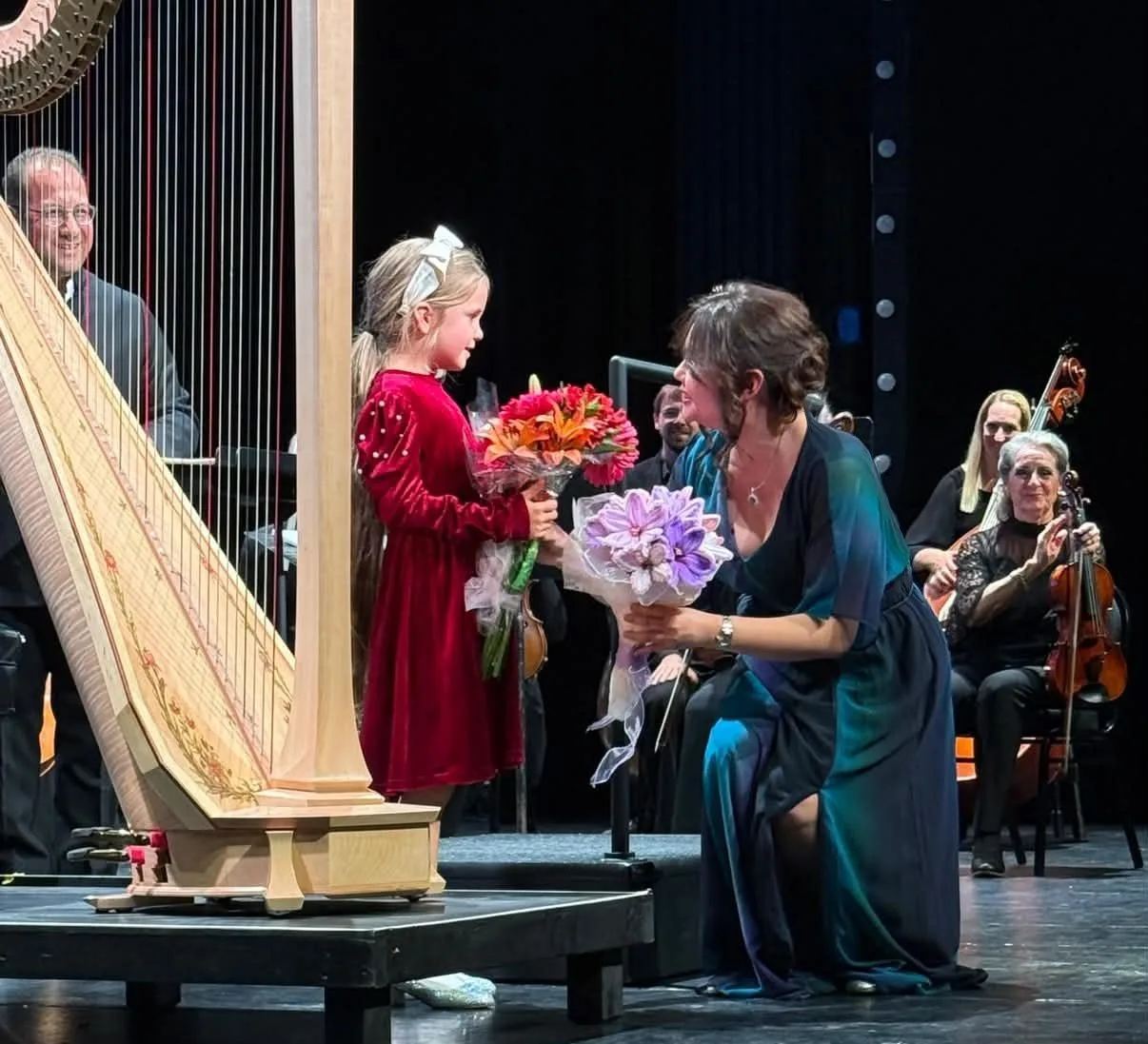
Guest soloist Joy Yeh joined the OSO for Rheinhold Gliere’s sweeping Harp Concerto. This masterpiece of Russian romanticism (written in 1938, but worthy of Tchaikovsky a half-century earlier) gives both the soloist and orchestra plenty of chances to dazzle–and dazzle they did. The orchestra’s confidence with this style was immediately apparent as they effortlessly pulled off the first movement’s soaring melodies, the second movement’s fairy-tale hush, and the third movement’s frantic folk dance with equal persuasiveness.
But of course the real star of this piece was the harpist herself. Harpist Joy Yeh really made her instrument sing, from the music-box-like lullaby that opens the second movement to the effect of a full, passionate choir in some of her thicker chords. And she delivered plenty of the shimmering virtuosity her instrument is known for–undoubtedly the inspiration for the title of the evening’s program.
Although it was the shortest and sparsest piece on the concert, the late Vancouver composer Jean Coulthard’s Prayer for Elizabeth felt like the emotional core of the program. Its exploration of more introspective elements of the human experience lent a sense of meaning to the more celebratory works that surrounded it. Written over 70 years ago for the CBC to commemorate Queen Elizabeth II’s coronation, it is a meditation on a young leader taking the throne amid the dizzying technological and social changes of the 1950s and the existential uncertainty of the Cold War.
The winds and percussion that added so much sparkle and bravado to the other pieces sat this one out, leaving the OSO’s string section to bare their souls. Their unity of tone and emotion was impressive, and made concertmaster Rachel Kristenson’s brief solos all the more poignant, giving the impression of a single voice pleading humbly over the crowd (presumably representing the young queen at the time of the piece’s composition).
The concert concluded with Music for the Royal Fireworks by Handel, which tied the Coulthard piece’s regal theme neatly together with the rest of the program’s shimmering, celebratory character. The orchestra succeeded in transcending the composition’s sometimes militaristic surface and bringing out the irrepressible joy that underlies this music.
The violin section was impressively tight as they rocketed up and down scales at breakneck speed (it was hard not to think of the piece’s titular fireworks whizzing through the air). And, as the icing on the celebratory cake, Pellicano (also an accomplished percussionist) left the podium to join the orchestra on snare drum for the piece’s finale, helping drive the music to its thrilling conclusion in an unexpected way.
In addition to Pellicano’s expert musicianship in leading the orchestra, his thoughtful programming choices really stood out. While the Handel gave more traditional classical audiences a bit of welcome familiarity, the other three pieces on the program (and particularly the two lesser-known pieces by Canadian composers) were every bit as compelling–and, arguably, more appealing to a broad audience.
I’m excited to hear more of what Pellicano brings to the OSO–as both a curator and a musical leader–over what we can hope will be a long tenure.
Nicholas Kelly is a Penticton-based composer. He completed a Bachelor of Music at Ithaca College in New York and a Master of Music at the University of British Columbia in Vancouver.